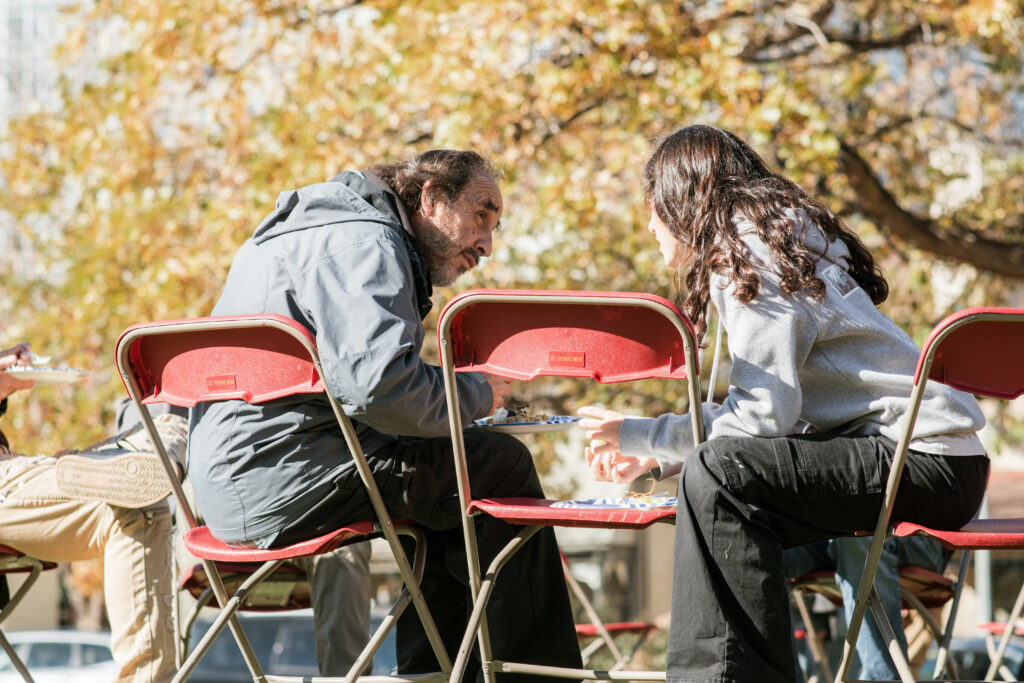
We are spending more than ever to “solve” homelessness.
Billions are funneled into housing initiatives, mental health programs, and addiction recovery. Yet, the numbers continue to climb. The crisis has shifted from something that breaks our hearts to something that, for many, simply fuels frustration or exhaustion.
We find ourselves asking: Why isn’t the needle moving?
Is it politics? Economic disparity? The opioid epidemic? While these are all critical factors, there is a deeper, more silent cause that no policy can reach and no check can fix. It’s a poverty we rarely measure: a poverty of loneliness.
The Root is Not the Roof
One of the most visible expressions of poverty in the United States is homelessness. But what is less visible is the relational void many people on the streets endure.
Many no longer experience real friendship.
Many have lost family connections.
Many live in a state of social invisibility.
Homelessness is often the physical manifestation of a total relational collapse. Beneath the layers of trauma, addiction, or financial ruin, there is a common denominator: Isolation. Most people who are just one or two “bad days” away from a crisis, are saved by a safety net of family and friends. For those living on the street, that net hasn’t just frayed, it has vanished.
Beyond the Transaction
As a society, we’ve become excellent at transactions. We hand out sandwiches, blankets, or a few dollar bills. Those things are good and needed. But transactions don’t heal wounds; relationships do.
A person can survive financial loss.
A person can rebuild after failure.
A person can recover from addiction.
But isolation makes recovery exponentially harder.
Human beings are wired for connection. When that connection disappears, hope often disappears with it.
In my work, I’ve realized that our most valuable asset isn’t our money or our ability to “fix” people. It’s our time. Time is the only resource we cannot grow or reclaim. When you sit on a curb or in a park with someone who has been rendered “invisible” by society, you are making a profound statement without saying a word. You are telling them:
“You have such immense value to me that I am willing to give you the only thing I can never get back.”
When we share our time with someone who has been ignored by society, we communicate something powerful without saying a word: You matter.
The Power of Presence
One of the most transformative acts is also one of the simplest: being present.
Not passing by but seeing the suffering person.
Not just handing out supplies. Not reducing a person to a transaction.
But staying without an immediate exit strategy.
Sitting down.
Listening and validating a story that the rest of the world ignores.
Sharing a few minutes of genuine attention.
Restoring dignity: Recognizing that before they are a “case study” or a “statistic,” they are a human being with infinite worth.
The first steps for a person living on the streets on their road to recovery often times are not good solutions, but the presence of a friend.
When a friendly conversation starts, it does not need to be profound. It does not need to solve immediate problems. It is an expression of recognition, a way of saying, you are worth my time.
A Challenge to Professionals
In the professional world, we are trained to be “problem solvers.” We want KPIs, ROI, and efficiency.
In a results-driven culture, we measure outputs: beds filled, meals served, dollars spent. These metrics matter. But they do not capture whether a person feels seen, known, or valued.
But human hearts don’t operate according to metrics or indicators.
If we want to actually change the landscape of our cities, we have to transform our culture from a “culture of help” into a “culture of encounter”. We have to move from looking at the poor as a problem to be fixed or managed, to seeing them as neighbors to be known or, even more, a person to be loved.
The next time you see someone on the street, remember: they may be hungry for bread, but they are starving for a witness to their existence.
Presence is the first step toward restoration.
What if one of the most scalable solutions is also the most human one?
What if addressing loneliness is not peripheral but foundational? What if it is the missing piece?